
The edge is the only part of a countertop you touch. Most of a stone surface is looked at; the edge is handled, leaned on and brushed past a hundred times a day, and it is the detail that tells you whether a kitchen was designed or assembled. Each profile below is a cross-section, drawn to scale against a standard three-centimetre slab, and every one is cut and finished in our Bridgeport shop.
A square edge with the sharpness taken off. Quiet, modern, and it disappears against contemporary cabinetry. The default for a reason: it makes the stone the subject rather than the edge.
A full half-circle across the slab thickness. Soft to the hand and forgiving with children, though it reads traditional and can make a thick slab look thinner than it is.
Rounded on the top, flat underneath. Sheds water away from cabinet fronts better than a full bullnose, which is why it earns its place in hard-working kitchens and around sinks.
A flat chamfer cut at an angle, top and bottom or top only. Catches light as a bright line along the whole run, which is striking on dark stone and nearly invisible on white.
An S-curve, concave over convex. The most decorative profile we cut and the most demanding to polish evenly. Right in a period Colonial, wrong in almost any minimal scheme.
A tight square step dropping into a curve. More formal than an eased edge without going fully traditional, and it holds a crisp shadow line along the top.
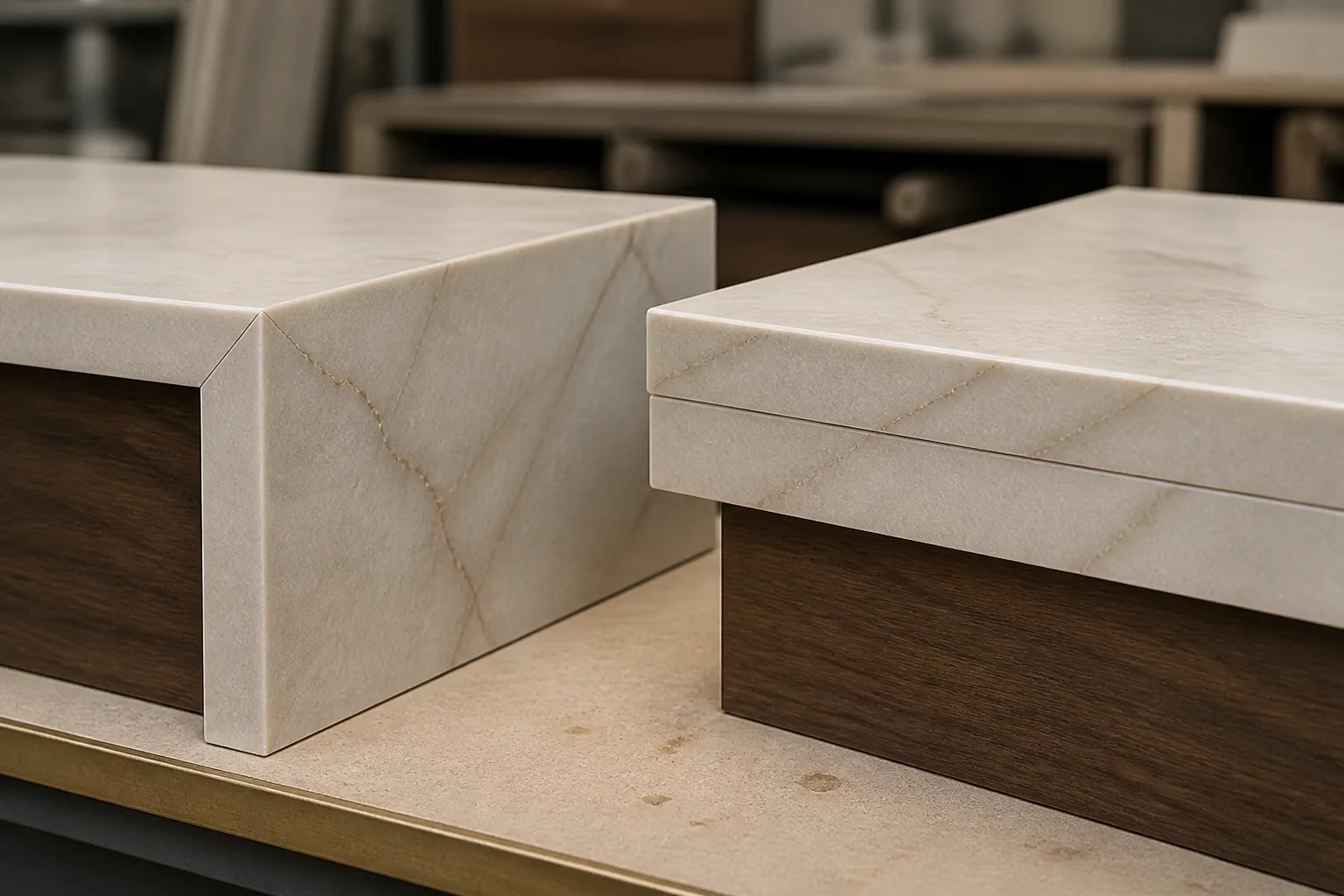
Two pieces cut at forty-five degrees and joined so the stone appears to fold and run to the floor. Done properly the veining continues around the corner uninterrupted. Done poorly the joint is the first thing anyone sees.
A second strip bonded beneath the front edge to double or triple the apparent thickness. How you get a six or nine centimetre slab look without the weight or the cost of solid stone that thick.
Two practical rules. Softer profiles are more forgiving with children and hips, and harder profiles chip more easily on brittle materials like porcelain and some marbles. And the busier your stone, the simpler your edge should be. A dramatic Calacatta with an ogee edge is two statements competing; the same slab with an eased edge lets the veining do the work.
Come to the yard and run your hand along the samples. Edge profiles are almost impossible to judge from a drawing and obvious within seconds in person.