
Granite is an igneous rock of interlocking mineral crystals, mostly feldspar and quartz, that cooled slowly deep underground. It is hard, heat proof and one of the least demanding natural stones you can put in a kitchen. It went out of fashion for a decade, and it is coming back now that people have lived with the trade-offs of quartz and marble.
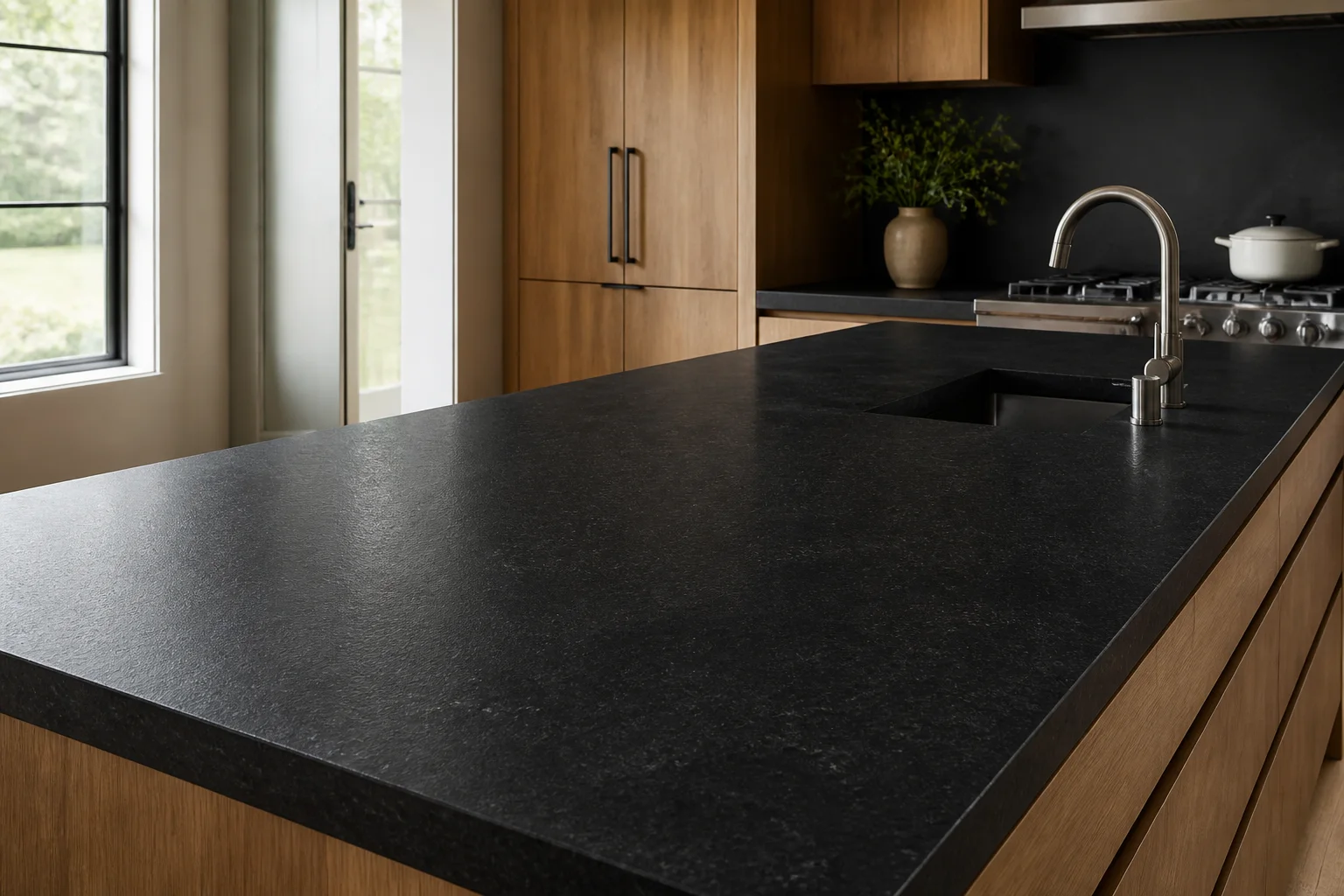
Granite's reputation comes from a handful of speckled brown and gold slabs that went into half the kitchens built between 1998 and 2010. Those are a small slice of what granite is.
Absolute Black, honed or leathered, is one of the best-looking surfaces we cut. Patagonia and Blue Bahia look more like abstract paintings than countertops. Some granites have the soft, linear movement people usually buy quartzite for, at a lower price. None of them show up well on a sample board, so come and see the full slabs.
Granite is porous and does need sealing, but the work involved is usually overstated, often by people selling quartz. A good impregnating sealer applied at installation typically lasts a year or more. The test takes ten seconds to set up: leave a few drops of water on the surface for fifteen minutes. If the stone darkens underneath, reseal. If the water beads, leave it alone.
Denser granites like Absolute Black are so low in porosity that sealing is close to optional. Lighter, more crystalline granites absorb more and want resealing annually.
Granite holds a crisp edge better than almost anything we cut, which makes it well suited to bevels, ogees and built-up laminated edges where a softer stone would round off. It is heavy, so islands and long unsupported runs need proper substrate and support planned before installation rather than improvised on the day.
Every granite countertop we make is templated, cut, edged and installed by our own team from our Bridgeport shop. Come and see full slabs by appointment.
The owners wanted a dark island that would not show every fingerprint, so we used Absolute Black with a leathered finish and a crisp bevel edge, set against pale perimeter counters. Granite holds a sharp bevel better than almost anything we cut, which is why we pushed for it over a softer stone.
See the project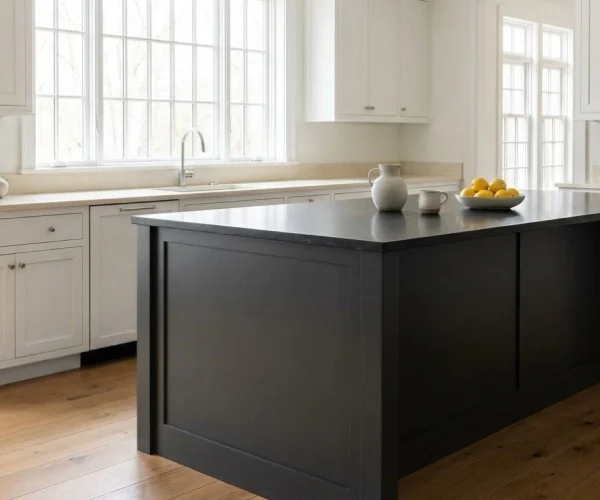
The ones we hear most at the yard. Anything else, call us at 203-717-1978.
The speckled brown and gold slabs from the early 2000s are. Granite as a material is not. Honed and leathered blacks, quiet whites and slabs with long linear movement look current, and they handle a working kitchen better than most alternatives.
Yes. A pan straight off the burner will not hurt the stone. The one place to be careful is a seam, where the epoxy can soften under long exposure to heat, so use a trivet there.
Most granite needs resealing every one to two years. Leave a few drops of water on it for fifteen minutes, and if the stone darkens underneath, reseal. Dense granites like Absolute Black can go years without it.
Polished is the most stain resistant and shows the color at its deepest. Honed is matte and shows oil and fingerprints on dark stone. Leathered has a soft texture that hides fingerprints and water spots, which is why we often suggest it for black islands.
Everyday granites usually cost less than mid-range quartz and well under quartzite, while exotic granites can match either. The slab is only part of the price. Edges, cutouts and seams matter too, and our estimate page explains what moves the number.
Granite is cut and edged in our Bridgeport shop and installed by our own crew. If you are weighing natural stone against engineered, compare it with quartz. Granite holds a crisp profile, so it is worth a look at our edge profiles, and smaller pieces often come from remnants. We fabricate granite for homes across the area, including Bridgeport, Trumbull, Stratford, Shelton and Monroe.
Granite varies more from slab to slab than anything we carry, and photos flatten it. Bring your cabinet plan or rough dimensions, walk the yard with us, and we will put the slabs you like on hold.
Book a slab-yard visitGet an estimate