
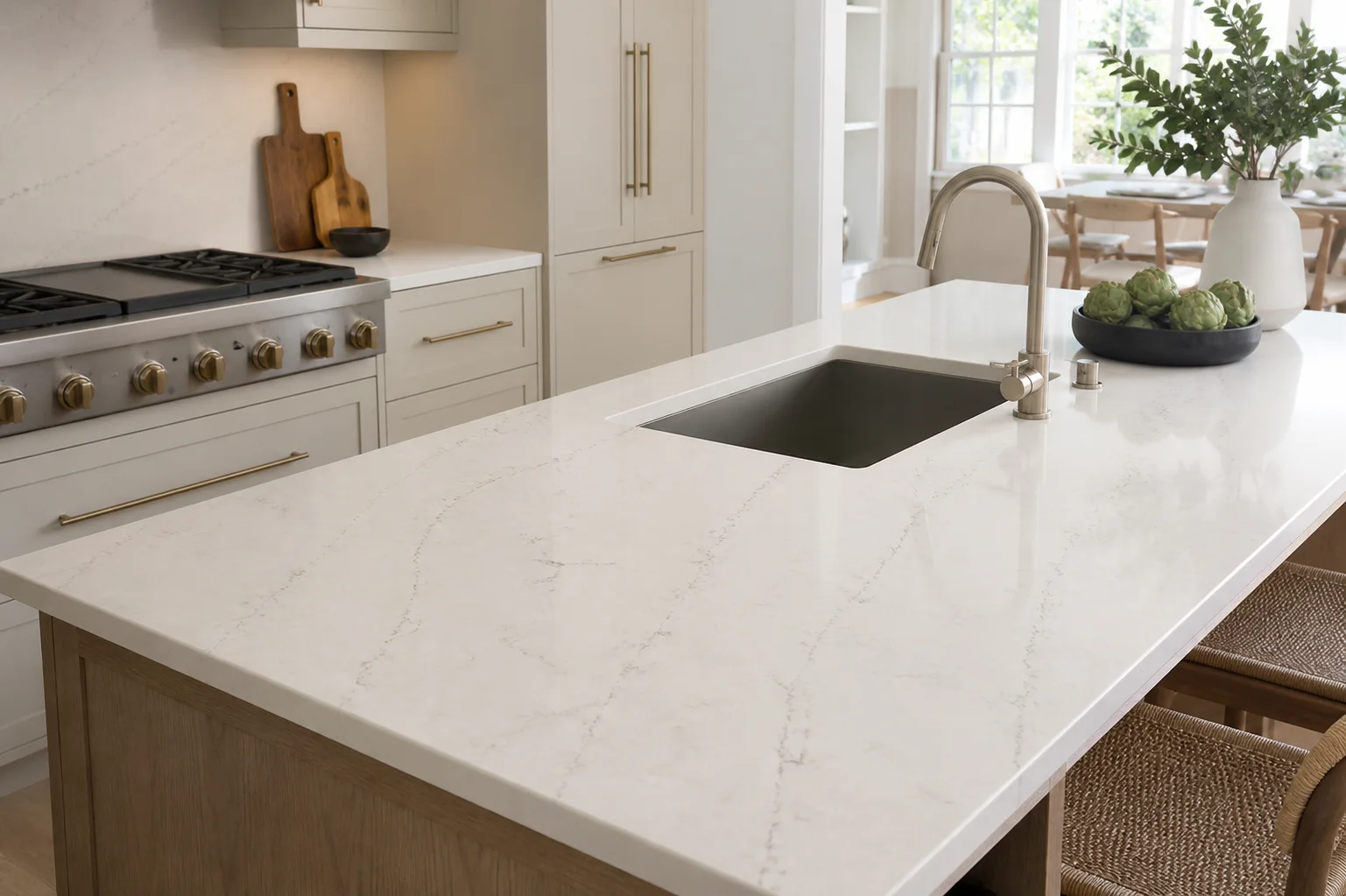
Engineered quartz is about ninety percent ground natural quartz, bound with pigment and resin. It is non-porous, never needs sealing, will not etch, and the slab looks the same as the sample. For a busy household that wants a white kitchen and does not want to think about the countertop again, it is usually the right call.
We are not tied to one manufacturer, so we can recommend on merit instead of on what we happen to stock. We regularly fabricate the major quartz brands and can order any color in their lines.
The names sound alike, and people mix them up all the time. Quartz is manufactured: ground stone and resin, made in a factory, uniform and predictable. Quartzite is natural stone quarried from the ground. It is harder than granite, every slab is different, and it is porous enough to need sealing.
If you want no upkeep and no surprises, choose quartz. If you want a one-of-a-kind stone that takes a hot pan and can live outdoors, choose quartzite. We keep both at the yard and will put them side by side, which usually settles it quickly.
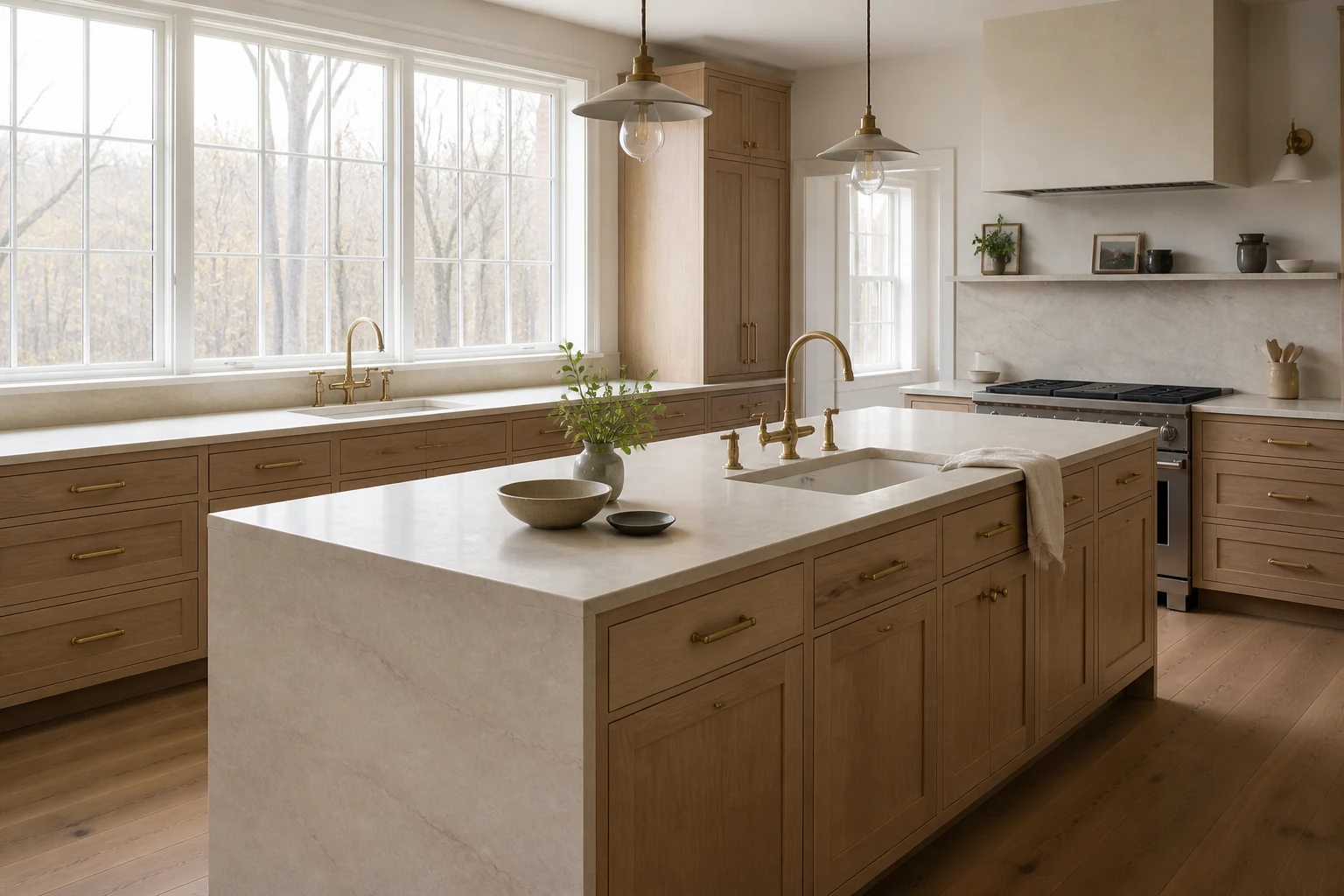
Quartz takes a crisp edge profile well and suits mitered waterfall islands, because its consistent pattern lines up around the corner without the careful vein matching natural stone needs. Every edge profile we cut is available in quartz, and all cutting, edge work and polishing happens in our Bridgeport shop.
Visit the yard by appointment to see full slabs rather than three-inch samples. Quartz patterns repeat on a large scale, and a sample chip tells you almost nothing about how a veined slab will read across a nine-foot island.
Quartz earns its keep in rooms that get used hard and cleaned fast: family kitchens, laundry rooms, kids' baths and rentals. It is also a good choice for a mitered waterfall island when you want the pattern to line up without hunting for a matching slab.
We steer people away from it for outdoor kitchens, sunrooms with strong afternoon light, and anywhere hot pots come straight off the range onto the counter. Granite, quartzite or porcelain handle those better.
The ones we hear most at the yard. Anything else, call us at 203-717-1978.
No. The resin that binds quartz can scorch or discolor under a pan straight off the burner, and that mark does not come out. Keep trivets by the range and you will never have a problem.
It is non-porous, so wine, coffee and oil sit on the surface and wipe off. Permanent marker, strong solvents and oven cleaner can damage the resin, so stick to soap and water or a pH-neutral cleaner.
Quartz never needs sealing and every slab matches the sample. Granite takes heat and sun, and every slab is different. Families who want no upkeep usually pick quartz. Serious cooks and anyone building an outdoor kitchen usually lean toward granite.
We do not recommend it. UV light yellows the resin over time, even on a covered porch that gets strong sun. For outdoor kitchens we use porcelain or granite.
Only if a run or island is longer than the slab. Standard quartz slabs are about ten feet long and jumbo slabs a little longer, and we place any seam at a sink, cooktop or corner where it is least visible.
Quartz slabs are cut, edged and installed by our own crews from our Bridgeport shop, not sent out to another fabricator. If you want natural stone with similar toughness, compare quartzite and granite, or read our quartz vs. quartzite guide. For vanities and laundry tops, ask about remnants. We fabricate quartz for homes including Trumbull, Shelton, Stratford and Monroe.
Quartz patterns repeat on a large scale, and a three-inch sample cannot show how the veining will read across an island. Come see full slabs side by side with quartzite, bring your cabinet plan, and we will help you narrow it down.
Book a slab-yard visitGet an estimate