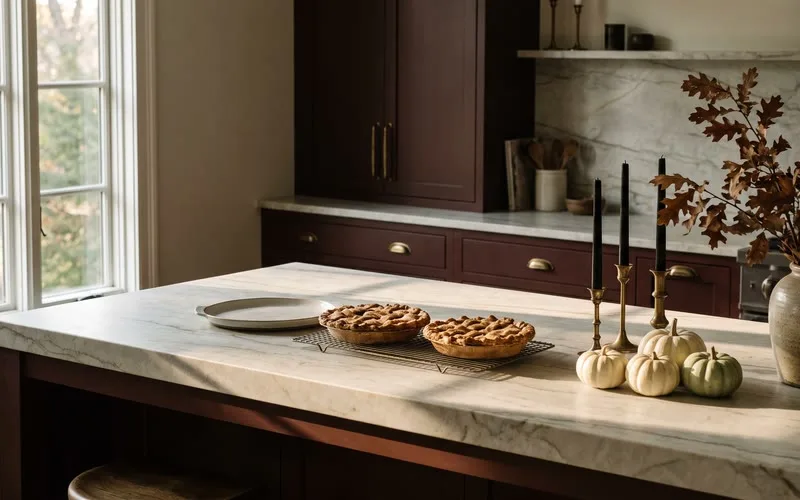
Eased, bullnose, ogee or a mitred waterfall: how each edge changes the look of the stone, the feel of the counter and the price of the job.
The edge is the part of a countertop you see from across the room, touch every day and lean against for twenty years, yet it is usually the last thing chosen. We cut and finish every edge we offer in our Bridgeport shop, so here is how the common profiles behave once they're in a kitchen.
Eased and pencil round
An eased edge is a crisp square edge with the sharpness taken off. It's the default in modern kitchens because it shows the stone instead of the tooling, hides wear well and is the simplest to produce. If you're unsure, start here. A pencil round softens the corner a little more, which is kinder to hips and easier on brittle stones.
Bevel
A bevel is a small angled cut along the top corner. It catches the light and looks sharp and tailored, especially on dark, dense stone. Absolute Black granite holds a bevel well; see our black granite island in Trumbull.
Bullnose and half bullnose
A full bullnose rounds the whole edge, and a half bullnose rounds only the top and keeps a flat face below. Both are soft and traditional, and they're kind to children at hip height. A full bullnose can look dated in a contemporary room, but it still suits a farmhouse kitchen or a bath.
Ogee and Dupont
These are the sculpted, S-curved profiles of classical kitchens. They need thicker material or a laminated edge, and they add hand-finishing time. In a paneled kitchen with inset cabinetry they look right in a way other edges don't. On busy, heavily veined stone the profile and the pattern compete, and the result can look fussy.
Mitred and laminated edges
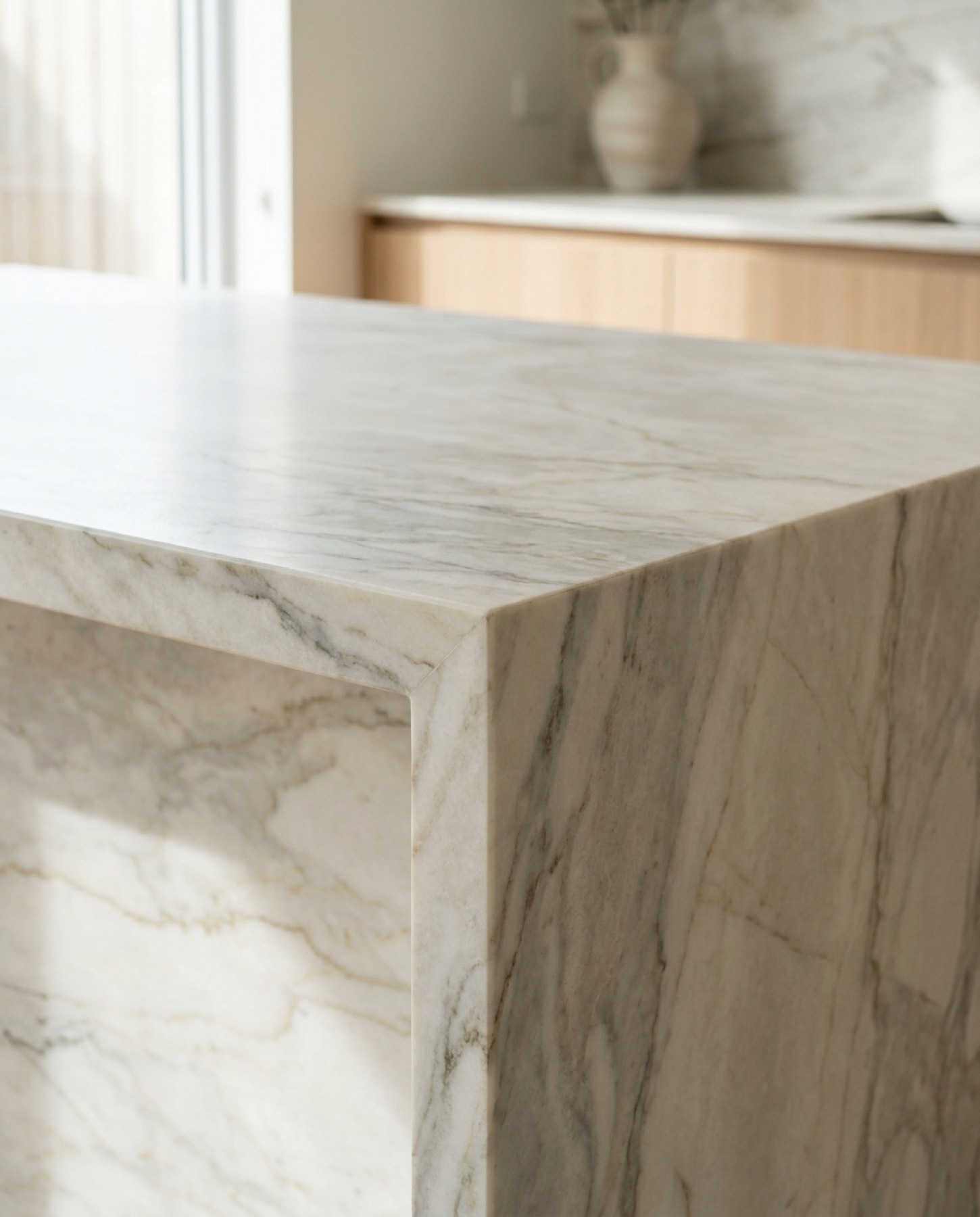
Slabs commonly come in two thicknesses, often called 2 cm and 3 cm. A mitred or laminated edge adds a strip of stone below the front so the counter looks thicker than the slab. A mitred apron is joined at forty-five degrees so the veining wraps the corner, which is how a thin vanity top can look like a solid block. See the mitred apron on our Calacatta Viola powder room vanity.
Mitred edges matter most on porcelain. Its pattern is printed on the surface and doesn't run through the body, so a plain cut edge shows a different color underneath. A built-up, mitred edge carries the pattern over the corner, as on our porcelain outdoor kitchen in Stratford.
The mitred waterfall
A waterfall is more a construction than an edge. The counter turns forty-five degrees at the end of an island and runs to the floor, with the veining carried around the corner. Both pieces come from neighboring parts of the same slab so the veining matches, and they're cut, mitred and joined so the stone appears to fold. There's more on our waterfall islands page.
How the stone changes the choice
Bold veining and strong patterns look best with eased or mitred edges, so save sculpted profiles for quieter stones. Sharp, hard profiles chip more easily on brittle materials, where a slightly rounded edge is more forgiving. Marble and soapstone wear at the corners over time, and a soft profile ages better on them. On porcelain, because the pattern sits on the surface, plan a built-up mitred edge wherever the edge is exposed.
Comfort and safety
Countertop edges sit at hip height for adults and face height for small children. In a kitchen busy with kids, a rounded or eased profile is the practical choice, especially on an island with seating. A crisp square edge looks clean in a quiet room but is less forgiving in a busy one.
Edges at the sink
An undermount sink adds an edge of its own, called the reveal, where the stone meets the bowl. A positive reveal sets the stone back so a thin ledge of the sink rim shows. A negative reveal lets the stone overhang the bowl slightly so the rim is hidden. A flush reveal lines the two up. We finish the cut edge inside the opening in the shop so it looks clean from above. Decide on the reveal with your sink in hand, before templating.
Thickness and overhangs
A thicker-looking edge doesn't need a thicker slab. A laminated or mitred edge builds up the front while the slab itself stays lighter, which also matters on tall cabinets and long overhangs. Seating overhangs need support sized to the stone and its thickness, so plan the overhang and the edge together, and have your cabinet installer and us agree on brackets or steel before templating.
Backsplash and side splash edges
A standard four-inch backsplash usually gets a simple eased top edge so it sits quietly against the wall. A full-height backsplash runs up to the cabinets or ceiling and needs no top edge at all, only clean joints at corners and windows. Side splashes at the end of a run are finished on their exposed edge to match the counter.
Keeping edges consistent
If the kitchen, bath and fireplace use different stones, a consistent edge ties them together. Most homes use one main profile throughout and save a mitred or more decorative edge for one feature, such as an island or a fireplace hearth.
When an edge chips
Even a well-chosen edge can take a knock from a cast-iron pan or a dropped bottle. Small chips in natural stone and quartz can usually be filled with color-matched resin and polished back by a fabricator or stone restoration professional, and they're hard to spot afterward. Rounded profiles chip less in the first place, which is one more reason they suit busy kitchens.
Edges on remnants and small pieces
Vanities, bar tops and hearths cut from remnants can take the same edge profiles as a full kitchen, and matching the main kitchen's profile is an easy way to make a small piece feel like part of the same house.
What drives the price
We don't publish prices, but the pattern is the same at most fabricators. Simple eased edges cost the least to produce. Rounded profiles add tooling time, sculpted ogees add hand work (usually charged per linear foot), and mitred and laminated edges add material and shop time. Waterfalls add the most, because they need extra slab as well as the mitre. For a quote on your project, see how our estimates work.
Seeing it before you choose
Edges are easier to judge in person than in a photo. Our edge profiles page shows each profile side by side, and when you visit the yard to choose your slab, bring a cabinet door and ask to see edges next to it. The right one is usually clear once it sits next to your actual stone and finish.
The short version
Match the edge to the room and the stone. If you're still undecided, choose eased. It keeps attention on the stone and works in almost any kitchen.